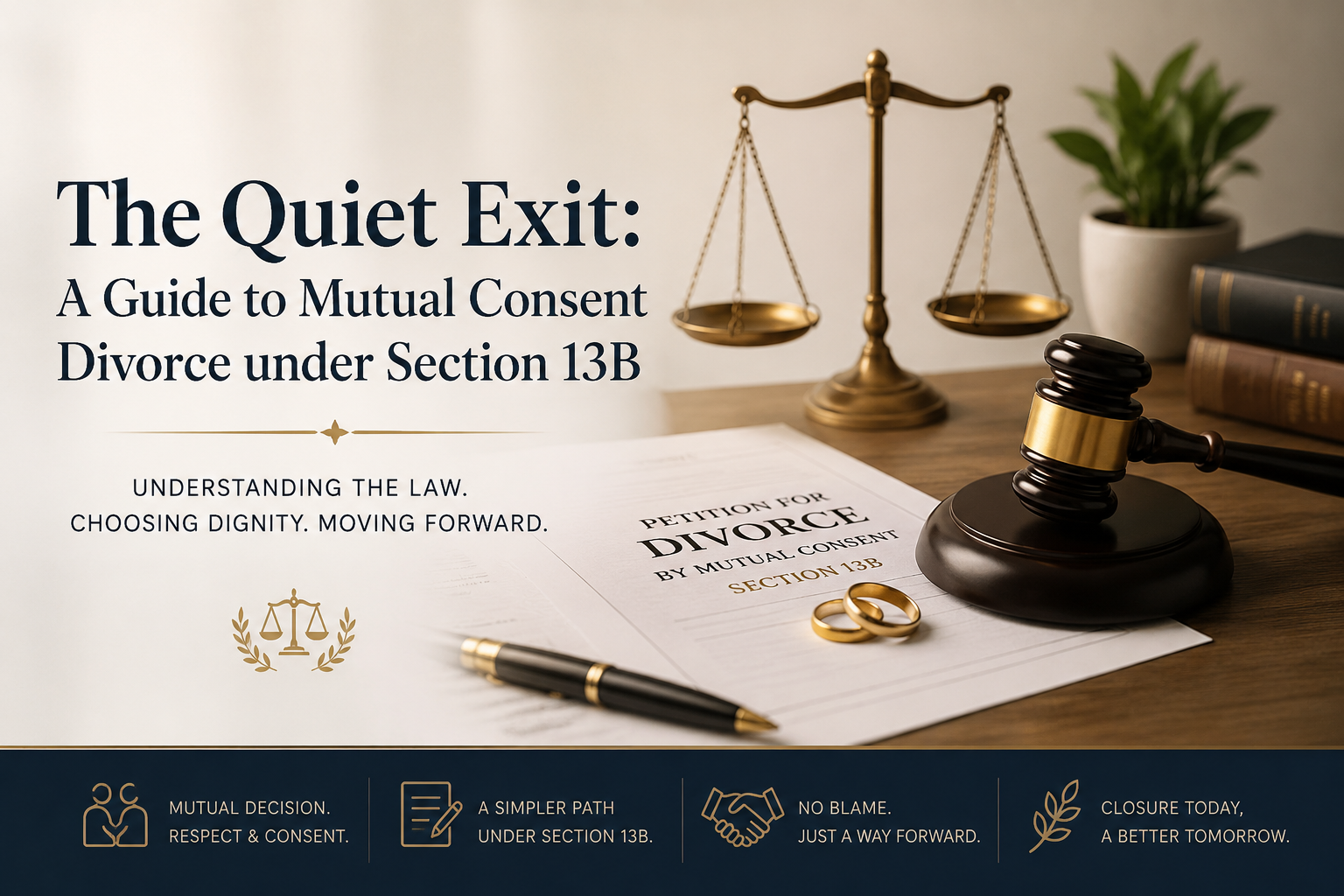
The Quiet Exit: A Guide to Mutual Consent Divorce under Section 13B
Inderpreet Kaur, Advocate
Associate Partner, JTS Lex.
(Author’s perspective)
Introduction
The legal landscape of Indian matrimony shifted fundamentally in 1976 (68 of 1976) with the introduction of Section 13B. Before this, divorce was primarily a "battle of blame," requiring one spouse to prove the other’s cruelty, adultery, or desertion. Section 13B replaced the boxing ring with a boardroom, allowing couples to exit a broken marriage with dignity rather than debris. In view this provision is not just as a legal exit strategy, but as a humane necessity for modern social stability.
Section 13B is built on the philosophy that if two people have the autonomy to enter a marriage, they must have the autonomy to leave it. The law requires three primary ingredients:
- 1. Living separately for at least one year.
- 2. An inability to live together any longer.
- 3. A mutual agreement that the marriage should be dissolved.
The Legal Blueprint
Section 13B is designed for couples who have reached a point of no return. To file, three criteria must be met:
• Separation: Living separately for at least one year (this can include living under the same roof but without a marital relationship).
• Mutual Agreement: Both parties must voluntarily agree to the divorce.
• Irreconcilability: Clear evidence that the couple cannot coexist as husband and wife.
The Author’s Viewpoint: Beyond the Cooling-off Period
From a personal perspective, the most debated aspect of Section 13B is the statutory "six-month cooling-off period" between the first and second motions. While the legislature intended this as a safety net against impulsive decisions, the judiciary has evolved. In the landmark Amardeep Singh v. Harveen Kaur case,the Hon’ble Supreme Court held that this period is directory, not mandatory. If a marriage is dead beyond hope, forcing a couple to wait six months is often an exercise in legal cruelty. We believe the focus should always be on the "irretrievable breakdown" rather than a calendar date.
Pop Culture and Practicality
We see Section 13B reflected in the nuanced storytelling of modern media. In the acclaimed series:• "Made in Heaven", several subplots mirror the silent exhaustion of couples who no longer wish to fight but simply wish to be apart. Unlike the high-drama courtroom brawls seen in 90s cinema.
• The "quiet goodbye" portrayed in "Decoupled", where the complexity lies in logistics—child custody and asset division—rather than proving who was the "villain" of the story.
• “Thappad” while it centred on a single incident, the legal journey highlights the importance of a woman’s right to say "I cannot live like this anymore" without having to prove a lifetime of trauma.
Day-to-Day Realities
In our daily practice, Section 13B manifests in diverse scenarios:
• The Career-Driven Split: Couples who have simply outgrown each other due to global postings and different life trajectories.
• The Amicable Co-parents: Spouses who realize they are better parents when they aren't living as a couple and choose mutual consent to protect their children from a bitter trial..
• The Strategic Exit: Where both parties agree on a one-time settlement (Alimony) to avoid years of litigation expenses.
Common Client Questions (FAQ)
1. Can I withdraw my consent after filing the First Motion?
• Yes. Consent must be present at the time of the Second Motion. If one party pulls back, the mutual petition may fail, and a "contested" route may become necessary.
2. How is alimony handled in mutual consent?
• This is the "Boardroom" phase. We help you negotiate a "Full and Final Settlement" that covers one-time alimony, jewellery (Streedhan), and property, ensuring no future litigations can be filed.
3. What about the children?
• Mutual consent allows parents to draft their own "Parenting Plan." You decide on visitation rights and holiday schedules together, rather than letting a court impose a rigid structure.
Conclusion
Section 13B of the Hindu Marriage Act is the legal embodiment of the phrase "let’s agree to disagree." It prioritizes mental health and future possibilities over past grievances.
This section is a tool for freedom, and a refined legal embodiment ensures that your "Quiet Exit" is legally airtight and emotionally sustainable.