No Borders, No Passports: The Global Reach of Personality Rights Violations
Sarvesh Kumar Tiwari,
Advocate & Founding Partner, JTS Lex
(Author's Outlook)
Abstract:
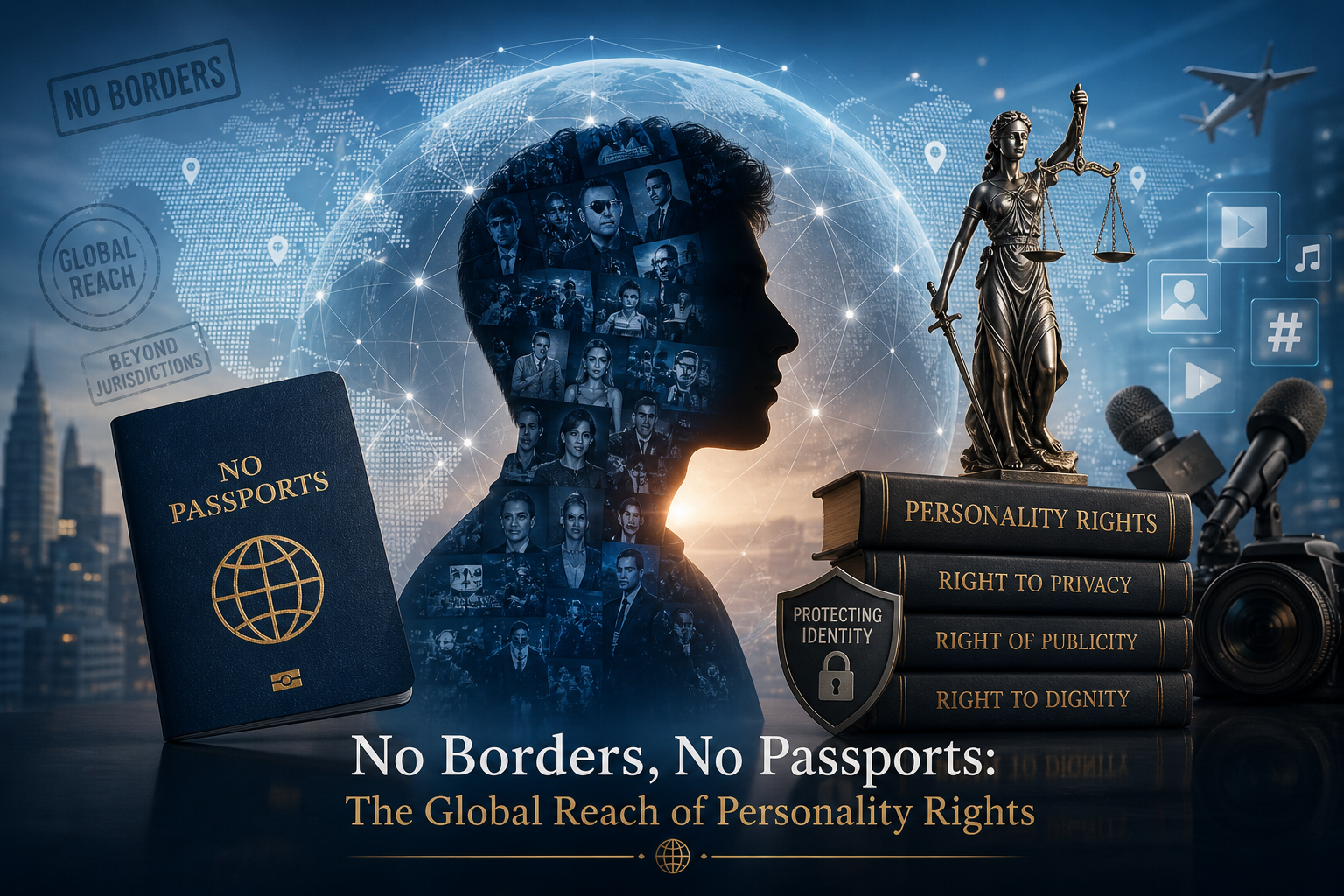
In an era defined by digital ubiquity and instantaneous global communication, personality rights encompassing dignity, privacy, reputation, image, and identity are increasingly vulnerable to violations that transcend territorial boundaries. Unlike traditional civil wrongs tethered to jurisdictional limits, infringements of personality rights operate in a borderless digital ecosystem, rendering classical doctrines of territorial sovereignty and jurisdiction inadequate. This article examines the evolving nature of personality rights violations in the global context, analyzes judicial responses in India and comparative jurisdictions, and argues for a harmonized, rights-centric framework capable of addressing transnational harms without passports or borders.
I. Introduction:
Personality rights are rooted in the intrinsic dignity of the individual. Traditionally protected through defamation law, privacy jurisprudence, and tort principles, these rights were once constrained by geography and jurisdiction. However, the rise of digital platforms, social media, artificial intelligence, and cross-border data flow has fundamentally altered the nature of harm. A defamatory post, misuse of a person’s image, or unauthorized commercial exploitation of identity today can originate in one jurisdiction, be hosted in another, and cause reputational damage worldwide.
In this context, personality rights violations no longer require physical presence, territorial access, or legal passports. The harm travels freely, often invisibly, challenging established legal frameworks premised on territorial sovereignty.
II. Conceptual Foundations of Personality Rights:
Personality rights refer to the bundle of rights protecting an individual’s personal attributes, including:
- Right to privacy
- Right to reputation
- Right to control one’s name, image, likeness, and voice
- Right to informational self-determination
While not always explicitly codified, these rights derive from constitutional guarantees of dignity and liberty. In India, Article 21 of the Constitution has been expansively interpreted to include privacy, reputation, and autonomy as integral components of the right to life and personal liberty.¹
Comparatively, European jurisdictions recognise personality rights as part of civil law traditions, particularly under German Allgemeines Persönlichkeitsrecht, while common law systems protect similar interests through tort and constitutional interpretation.
III. The Borderless Nature of Modern Violations:
A. Digital Platforms and Global Dissemination:
The internet enables instantaneous dissemination of content across jurisdictions. A single post, video, or deepfake can irreversibly damage reputation across multiple legal systems simultaneously. The victim’s domicile often becomes irrelevant to the locus of harm.
The Supreme Court of India has acknowledged this shift, observing that privacy violations in the digital age are qualitatively different due to their scale, permanence, and global reach.²
B. Commercial Exploitation and Identity Theft:
Unauthorized use of a person’s image, name, or likeness for commercial gain particularly by multinational corporations or digital advertisers raises complex jurisdictional questions. The harm may be felt where the individual resides, while the economic benefit accrues elsewhere.
C. Deepfakes, AI, and Synthetic Media:
Emerging technologies have further eroded borders. AI-generated impersonations and synthetic representations intensify personality rights violations by making attribution, authorship, and enforcement exceedingly difficult. Traditional remedies such as injunctions or damages struggle to keep pace with the velocity of such harm.
IV. Jurisdictional Challenges and Judicial Responses:
A. Territoriality vs. Effects Doctrine:
Courts increasingly rely on the effects doctrine, asserting jurisdiction where harm is suffered rather than where the act originated. Indian courts have applied this approach in internet-based defamation and privacy cases, recognizing that reputational harm is experienced at the place of the plaintiff’s residence or professional standing.³
B. Indian Jurisprudence:
In Justice K.S. Puttaswamy v. Union of India, the Supreme Court constitutionalized privacy, emphasizing informational autonomy and dignity in a digital society.⁴ Subsequent High Court decisions have extended protection to personality rights of celebrities and private individuals alike, particularly against unauthorized online exploitation.⁵
C. Comparative Perspective:
The European Court of Human Rights has consistently held that reputational harm and privacy violations engage Article 8 of the European Convention on Human Rights, even when actions occur beyond national borders. ⁶ Similarly, U.S. courts have grappled with jurisdiction in online defamation, balancing free speech with reputational interests.
V. Inadequacy of Existing Legal Frameworks:
- Fragmented enforcement across jurisdictions
- Lack of harmonised international standards
- Platform immunity and intermediary liability shields
- Difficulty in quantifying transnational reputational harm
Domestic laws, drafted for a territorially bounded world, struggle to provide effective remedies for violations that are inherently global.
VI. Towards a Harmonized Rights-Centric Framework:
- Recognition of Personality Rights as Human Rights
Anchoring these rights in international human rights law would strengthen cross-border enforceability. - Jurisdiction Based on Harm and Dignity
Courts should prioritise the situs of harm over the place of origin. - Enhanced Intermediary Accountability
Digital platforms must bear proportional responsibility for enabling and amplifying violations. - International Cooperation and Soft Law Instruments
Model laws, bilateral treaties, and transnational guidelines can bridge jurisdictional divides.
VII. Conclusion:
In the digital age, personal identity moves without borders, exposing individuals to personality rights violations that are instantaneous, borderless, and enduring. Deepfakes, voice cloning, and digital impersonation have rendered traditional, territorially bound legal responses inadequate. While Indian courts have advanced constitutional protection of dignity, privacy, and autonomy, judicial intervention alone cannot address the scale and complexity of these harms.
India must adopt a coherent national framework recognizing personality rights as essential digital and civil rights of every individual not privileges limited to public figures. Such a regime must harmonize civil remedies, criminal sanctions, platform accountability, and preventive technological safeguards, supported by uniform jurisdictional access, public awareness, and digital forensic capacity.
As harm now travels without passports, legal protection must move just as freely guided not by territorial rigidity, but by the constitutional commitment to dignity, equality, and justice.
References
- Maneka Gandhi v. Union of India, (1978) 1 SCC 248.
- Justice K.S. Puttaswamy v. Union of India, (2017) 10 SCC 1.
- Swami Ramdev v. Facebook Inc., 2019 SCC OnLine Del 10701.
- Justice K.S. Puttaswamy v. Union of India, (2017) 10 SCC 1.
- Titan Industries Ltd. v. Ramkumar Jewellers, 2012 SCC OnLine Del 2382.
- Von Hannover v. Germany, (2004) 40 EHRR 1.